Skip the foundations and you end up paying twice. Discovery is the two to four weeks that makes everything after it cheaper, faster and more likely to work.
So many businesses skip the foundational work. The strategy, the positioning, the planning feel slow. There are campaigns to run, products to launch, targets to hit. So it gets skipped, or deferred, or done superficially, and the business jumps straight to tactics because tactics feel like action.
The result is familiar: campaigns that miss because the messaging was never defined, budget on channels that were never right for the audience, a brand that looks slightly different everywhere. Eventually someone suggests going back to do the foundational work. Only now there is remedial work on top of it. You pay twice.
What a good marketing strategy actually solves
Who you are selling to, specifically
Not 'the trade'. Which distributors, which retailers, which designers and specifiers, and what each needs to hear.
What your products should say
Positioning and messaging that is true, distinctive and consistent, so the brochure, the stand and the LinkedIn post all sound like the same company.
Where the money goes
Channel choices made from the buyer universe outwards, including a clear list of what not to spend on.
What happens next
A six-month plan per channel, built around the trade calendar, that your team or mine can run from Monday.
How you’ll know
Objectives, KPIs and a budget that aligns with the ambition. Marketing without this structure is not a strategy. It is a hope.
How I investigate a business
Growth doesn’t come from guesswork. It starts with asking the right questions, challenging assumptions, and creating clarity. In a Full Discovery, that means spending time with the people who know the business best, and then looking at it from the outside.
Materials and finishes
01
A leadership day
Where the business is, where you want it to go, what has and hasn’t worked, and what you believe about your customers.
02
A sales team day
The people on the road know what the market is saying. What they hear, what they need, what gets in the way.
03
Customer conversations
Distributors, retailers, designers: why they buy, why they don’t, and what they’d say about you to a colleague.
04
A marketing and asset audit
Website, imagery, literature, channels, data. Strengths, gaps and what can be reused.
05
Competitor and market review
Who you are really up against, how they are positioned and priced, and where the gap is.
Strategy in practice.
From the project archive · Triangle
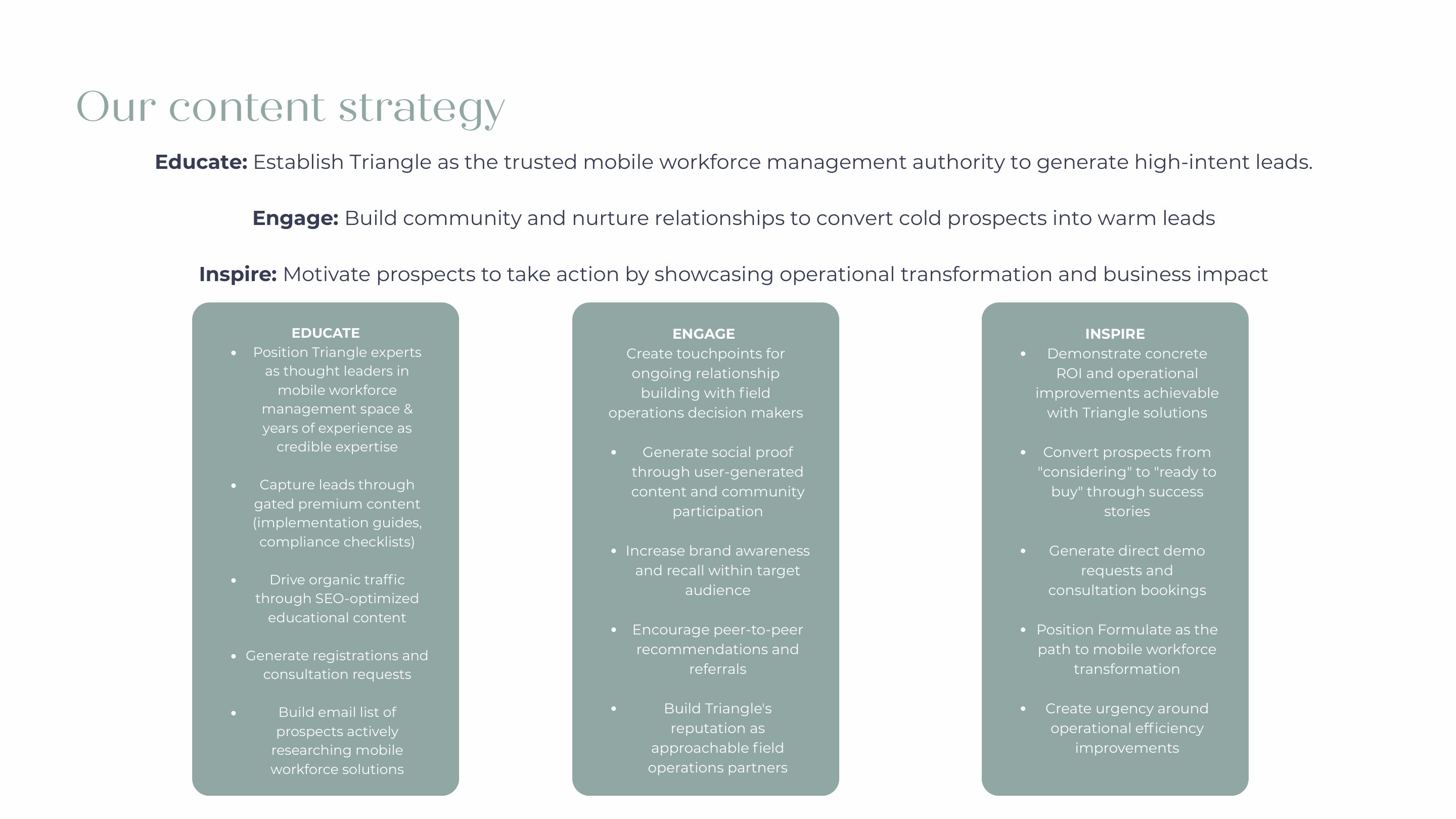
A strategy that gives content a job.
An excerpt from Triangle’s 2025/2026 content strategy: three complementary roles for content, connected to the buyer’s journey.
01
Educate
Attracts prospects researching solutions
02
Engage
Nurtures and builds relationships over time
03
Inspire
Converts warm prospects into sales opportunities
View the original strategy excerptTriangle Content Strategy, 2025/2026 · Page 3.The Triangle case study
The Strategy Blueprint
Seven layers, in the order I work through them. Each one depends on the one before it, which is why the sequence matters more than the speed.
What the business needs marketing to do: turnover, new accounts, specification, a new market. The constraints that come with it: budget, people, the trade calendar.
You receive. Agreed objectives and the measures that will tell us if we got there.
Who you are really competing with for the same specifier, the same shelf, the same project. How they position and price themselves.
You receive. A competitor and market review, with the gap you can own.
The distinct groups that decide whether your product sells: distributors, independent retailers, contractors, architects and designers, end users. What each one needs to hear, and in what order.
You receive. An audience map with a message and a reason to act for each.
Positioning, key messages and tone of voice that are true to the business and distinct in the market. Inspiration first, specification detail second, where designers are the audience.
You receive. Positioning, messaging and tone of voice guidelines.
Which channels earn their place for these audiences, which shows and titles matter, and what we will not spend on.
You receive. A channel strategy with priorities, and a trade calendar.
A six-month communications plan for each channel, built around the key events, with who does what and when.
You receive. The six-month plan, ready to run.
Monthly reporting against the objectives, honest reviews, and the confidence to stop things that aren’t working.
You receive. A reporting rhythm and a review at six months.
01
The business
What the business needs marketing to do: turnover, new accounts, specification, a new market. The constraints that come with it: budget, people, the trade calendar.
You receive. Agreed objectives and the measures that will tell us if we got there.
What you receive
Two depths of discovery. The right one depends on how much is already known and how much is riding on the answer.
One-off · Around two weeks
Marketing Review
A starting point to get you to market with confidence.
Review of what you have today, including your website and existing imagery
Competitor analysis and price point review
Brand and tone of voice recommendations per audience
Recommendations on how to go to market
Outline marketing strategy
Six-month comms plan to work from for each channel: social, email, PR
Fee quoted in conversation.
One-off · Around four weeks
Full Discovery
Everything in the Marketing Review, taken deeper.
Conversations with you, your sales team and your customers
Full competitor and market analysis
Positioning, messaging and tone of voice guidelines
In-depth website and content review
Detailed marketing strategy by audience and channel
Six-month comms plan for each channel, including a detailed marketing plan built around your key events
Fee quoted in conversation.
A written strategy you can take away and run yourselves, or ask me to lead.
An illustrative six-month roadmap
Every plan is built around the client’s own calendar. This is the shape of one, for an imagined flooring brand with a spring show and a new range in the autumn. It is an example, not a client’s plan.
Illustrative six-month marketing plan for an imagined flooring brand, by channel and month
Channel
Month 1
Month 2
Month 3
Month 4
Month 5
Month 6
Trade PR
Launch release
Show preview
Show review
–
New range release
Project feature
Social
Foundations
Show build-up
Live from the stand
Projects
Range teaser
Range launch
Email
Database clean
Show invitation
Follow-up
Retailer update
Specifier update
Range launch
Shows and events
Stand brief
Pre-show
Spring show
–
–
Autumn planning
Sales support
Toolkit audit
Show materials
Lead handover
Retailer POS
Range samples
Specifier pack
Review
Baseline
–
Quarter review
–
–
Six-month review
Strategy only, or strategy and implementation
Some clients take the strategy and run it themselves. Some keep me on to lead implementation, with the account manager and specialist partners behind me. Either is fine. The strategy is written so it works both ways: a complete, senior-level plan to run with, regardless of what happens next.
“Working with Eve has been a game changer. Her strategic insight hasn’t just improved our marketing; it’s helped us reshape the direction of our business. From lead generation to brand clarity, her ongoing consultancy has given us the confidence and capability to scale effectively.”
Questions I’m usually asked
What should a manufacturing marketing strategy include?+
Who buys and who specifies, how they decide, where the product sits against the alternatives, what it should say to each audience, which channels actually reach them, and a plan with objectives, KPIs and a budget that matches the ambition. The Strategy Blueprint on this page is that list, in order.
How do interiors brands market to architects and specifiers?+
Specifiers choose early and rarely change their minds, so the work is done before the project exists: technical information that is easy to find and trust, samples and CPD where they help, case studies of installed work, and a consistent presence in the titles and directories designers use. It is patient marketing, measured in projects won over years rather than clicks this month.
05 · Behind the Thinking
From the journal
Eve’s own writing on the thinking behind this work.
Rebranding is one of the most expensive decisions a business can make. Before you pull the trigger, it’s worth asking a more important question: is your brand actually broken, or does it just feel that way to you?
Ask ten marketers what their non-negotiable is and you will get ten different answers. Mine is always the same: branding. Here is why it underpins everything else you do.
Before you decide
Is this the right support?
Who it suits
For a launch, repositioning or change of direction where the business needs to clarify its audiences, proposition and marketing priorities.
What the engagement covers
A focused marketing review or deeper discovery, leading to recommendations and a six-month plan. Research depth and deliverables depend on the agreed brief.
When another route may fit
If the direction is clear but nobody owns delivery, consider implementation or fractional leadership. Discovery does not require an ongoing retainer.
Scope and fees
Fees are quoted after a first conversation, based on the time commitment, what’s being delivered and any specialist support needed.